Benefits of Automation
Brief Summary:
There are many steps to take when automating a process but if done correctly, automation can offer many advantages. These advantages include an improved process while decreasing costs. When choosing to automate, many companies should look for outside help to ensure the system runs smoothly.
- Successful automation can improve part quality, increase throughput, and reduce costs. It also increases the likelihood of success, but not all parts or processes can be automated. A capable integrator recognizes what to automate and what not to automate and makes sure the simple parts meet necessary tolerances for automation.
- Production efficiency and a speedy return on investment are some of the benefits you can receive from planning early and planning well
- Using a robotics integrator fits with the recent trend toward outsourcing; you get the best an integrator has to offer without adding to your payroll.
- There are many factors critical to making the final choice. Consider the expertise of the integrator organization, its process development capabilities, available product offering, application engineering resources, safety equipment and training and service support.
- The most successful robotic welding system integrators offer their customers the following personnel resources:
- Sales engineers to serve as the first point of contact. They are familiar with the latest and most innovative solutions available.
- Project managers who have backgrounds in manufacturing and understand manufacturing processes and how the robotic system plays a part in those processes. They provide the concept for the robotic solution to the manufacturer and offer direction in choosing the equipment mix that best matches production goals.
- Application engineers who understand the welding process and how the robotic work cell's components interact with one another. They are responsible for tying the hardware components together so they work as one, such as robot programming, process development and PLC programming.
- Competent technical service engineers help customers deal with any hardware and software problems that arise.
- Robotic welding systems integrators must maintain a staff able to anticipate customer needs. A systems integrator can be a key partner that provides engineering resources to provide wide-range support from lead engineering to process development.
- Not every welding process is a good candidate for automation. An experienced integrator can assist with evaluating the process.
- Provide the primary goals you want to accomplish with automation (reducing costs, increasing throughput, improving quality and consistency, etc.). The integrator's goal is to gain as much information as possible about quantities needed, number of shifts worked, inches of weld per part, expected ROI and the quality and repeatability of parts entering the weld cell.
- A robotic systems integrator can provide insight into the manufacturability issues of parts, particularly for robotic automation. Reviewing part designs is yet another role integrators can play. They can help you understand how the design affects your manufacturing process. The integrator can be an extension of your engineering department and work with your project managers to look at long- and short-term production goals to maximize benefits from the new equipment.
- Flexible, modifiable robotic work cells can lead to increased productivity. A Versa 4 work cell from Genesis features a Ferris-wheel-style positioner, fast indexing time and servo tooling that helped customer Herman Miller weld 6 of its 50 standard frames. These 6 frame styles, however, comprise 50% of the company's product.
- An asset a systems integrator can offer is access to multiple equipment options and configurations that ultimately lead to better productivity . Some integrators offer pre-engineered or standard work cells. These systems provide out-of-the-box affordability, but are not always the right solution when customization is required. Integrators with flexible, modifiable work cells can provide a cost-effective solution tailored to the application.
- Following are some equipment suggestions for productive robotic welding.
- Positioners. The positioner determines how the part is presented to the robot for welding. Typical positioner types include stationary tables, turntables, headstocks, tailstocks and Ferris wheel types.
- Fixtures. These hold the part to proper tolerances for welding. Unique to each automation project, fixtures are only as good as the quality and innovation the systems integrator puts into them. When selecting a robot, the integrator considers accuracy, speed, reach, operator interface and the various options available with each robot.
- Base Platform. A common base platform, which the systems integrator designs and constructs, connects all components. It is also a base for controls, flash screens, barriers and safety components.
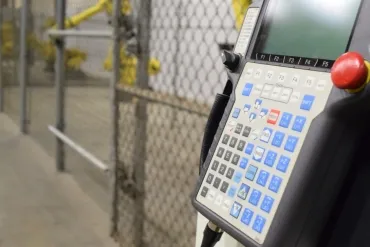
- Operator Interface. This is the final component of the work cell. Simple push buttons, or a touch-screen panel, are often recommended interfaces. Safety should lead the priority list of any systems integrators. Robotic welding systems integrators most concerned about reducing the risk of injuries have adopted the Robotic Industries Association's (RIA) Code for Robotic Safety, a guideline widely accepted as the industry standard.
- You should expect systems integrators to conduct a risk analysis and then design and adjust systems for the safest operation that meets or exceeds all plant, federal, state and local codes.
- One of the best methods for worker safety is adequate training conducted by the systems integrator. A hands-on, mentoring approach works well with employees in the welding industry who are comfortable working with their hands.
- Service and support can make or break the relationship between you and your systems integrator. The high capital costs of robotic welding systems mean you have the right to demand efficient, fast service when something goes wrong. And just-in-time (JIT) inventories no longer allow you the luxury of downtime.
- Service and support begins with the integrator's warranty. Technical phone support handled by experienced service engineers is the next contact. If the equipment is a recent installation, the project manager who handled it for the systems integrator may be the best resource for pinpointing solutions to problems.
- Robotic equipment can break down after normal business hours. Customer-sensitive systems integrators have 24-h hotline telephone service and require technical staff to be on call to avoid delays in responding to worried customers.
- A competent robotic systems integrator is one of the best investments you can make when it's time to improve the production process and productivity. Checking references and visiting other plants where the systems integrator has handled an automation changeover can help you choose the best systems integrator for fulfilling your requirements.
To read the original article please click:
http://www.aws.org/wj/aug01/feature3.html