
Regulations give robots edge in food industry
Food material handling robots are able to create a very sterile environment that creates more consistent and higher quality results on the production line. When abiding by strict food regulations, industrial robots are able to easily maintain the standards and keep the production line squeaky clean.

Due to regulations passed in 2011, material handling robotics now have the edge in the food and beverage industry.
In January 2011, President Barack Obama signed The Food Safety Modernization Act. This act gave the Food and Drug Administration power to regulate how food is grown, harvested and processed. This law was proposed following several outbreaks of food-related illness and tainted food during the 2000s.
Since manual applications of food handling have a higher rate of error and chance of contamination, material handling robots are being brought in so facilities can hold up to the new standards and regulations.
Not only do robots promote a more sterilized environment, they also take more precise counts during production, which leads to the ability to track a package that might be tainted back to its origins.
Food material handling robotic systems have a protection rating of IP 67, meaning that they are not only coated to withstand rusting and growth of bacteria, but they are also dust-proof. These robots are versatile enough to perform several different material handling applications, including pick and place and packaging.
Along with standing up to regulations, food material handling robots speed up production. Some robots can pick 220 food items per minute. The food material handling systems also raise safety levels by removing human workers from taxing, tedious and sometimes injury-inducing jobs.
There are several food-grade approved robots available through Robots.com, an integrator of robotics from Fanuc, KUKA, ABB, Universal Robots, and Motoman.
If you are ready to start automating your food and beverage handling processes, contact the Robots.com sales department at 877-762-6881 to begin designing your food material handling robot system.
Related Articles
You might be also interested in:
- Industry Solutions
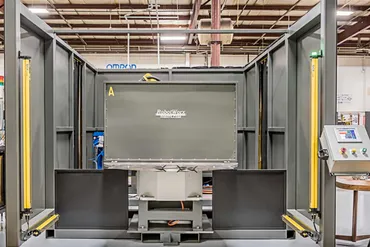
Setting up an efficient shop floor with robots
If you are considering integrating with industrial robots on your production line, it will help to plan your workspace properly for the greatest efficiency. Shop floor efficiency will be increased based on the five elements that are listed. This thoughtful layout will help you stay competitive in the manufacturing world.
- Industry Solutions
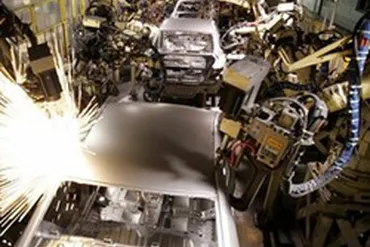
Reinventing Automotive Assembly with Robots
On the automotive assembly line, industrial robots perform faster and cheaper making them a better choice for manufacturers. The automotive assembly robots can be fitted with vision, making them more precise and create a more consistent product.
- Industry Solutions
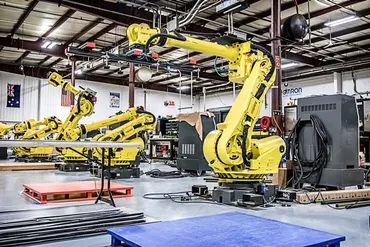
Foundry and Lean Manufacturing in Clyde, Ohio
The state of Ohio has a wide range of manufacturing businesses that have integrated industrial robots to improve their processes. The robotic technology that has been integrated has helped industries of all types such as steel cutting and molding plastics.
- Industry Solutions
Six-axis robots add flexibility to automotive component adhesives
For automotive production lines, six-axis robots are the solution for added flexibility and productivity. When compared with four-axis robots, six-axis robots add high levels of flexibility and enhance the automotive adhesive component. Six axis robots can perform operations that need to meet specific cycle times.
- Industry Solutions
They Can Take The Heat - Foundry Robots
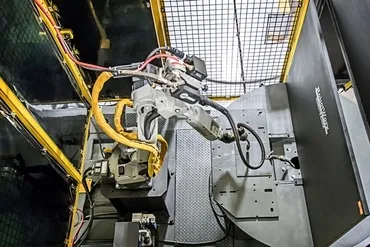
A foundry robot can work in hazardous conditions without being damaged or effected. They help to remove humans form the harmful environment and hazardous materials that are present during this application. Foundry robots are up to the heat challenge and help to successfully complete a wide range of tasks in a more productive and efficient manner.
- Industry Solutions
Automotive Machine Loading Robots
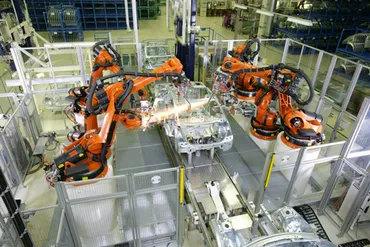
Using machine loading industrial robots on the automotive line has increased the production speeds, cut costs, and increased the product quality. Machine loading robots are able to handle a variety of jobs and accomplish the job of a human worker in half the time.
Let's talk!
Request your quick quote today.