
Environmentally-Friendly Robots
A robot can reduce large amounts of waste during the application process, helping to improve the environment. This helps to decrease the pollutants in the air, on the earth, and decrease the need to dispose increased waste. Robots can also be refurbished to like new condition which also demonstrates how one can reuse the materials in a way to benefit the earth.

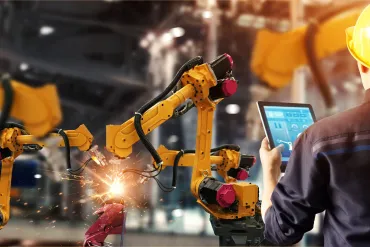
When people think about robots, all they tend to think about are these hard, metal monsters that work in factories surrounded by more metal, concrete and brick. However, did you know that even robots are trying to become more environmentally-friendly? As companies continue to go “green,” robots are leading the way as friends to the environment outside their concrete walls.
One of the easiest examples of their friendliness to the environment is a robot’s ability to reduce the amount of waste during their application processes. For example, when a robot is painting an item, it uses less paint to cover the work piece than any manual application would apply. This means that less paint is used, and less is wasted. Wasted paint, along with other pollutants have to be properly disposed of so they do not leak into ground water, and the use of less paint means less paint, which means less of a chance of contamination.
There is also the market for refurbished robots, probably demonstrating the most environmentally-friendly aspect of all. Companies like Robots.com buy refurbished robots from other companies, and they use processes like dry ice blasting to clean the robots, which does not waste water, and then they repair them and get them out to other consumers. This ability to reuse machinery means that the pieces will not end up in a dump somewhere. Also, Robots.com sell robots from companies like Fanuc, Motoman, KUKA, Universal Robots, and ABB, uses old robots that are no longer able to work. They are able to reuse pieces of the robot, like the base, to make a base for work cell positioners. This type of recycling is also friendly to the environment.
So, are you trying to go green? Would you like to know more about Robots.com and the refurbished robots they have available? If so, contact Robots.com online or at 877-762-6881.
Related Articles
You might be also interested in:
- Innovation & Trends
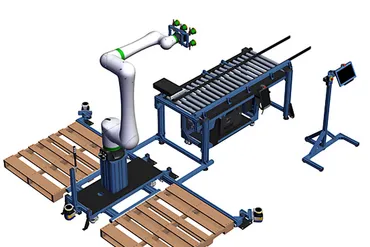
Palletize with Precision: T.I.E. Industrial's Cobot Solutions
In the dynamic world of manufacturing, efficiency and flexibility are key to staying competitive. T.I.E. Industrial, a leader in providing advanced robotic solutions, is proud to offer turnkey solutions in Cobot Palletizing Cells, primarily featuring Fanuc Robots and Vention technology. These solutions are designed to revolutionize the way products are palletized, offering unmatched precision, efficiency, and ease of integration.
- Innovation & Trends
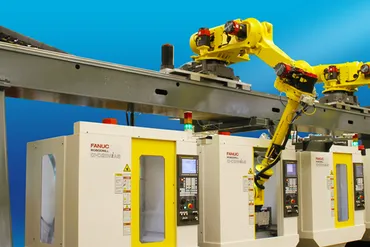
Robotic Molding Process
Molding companies are realizing that the molding process can be enhanced through automation. Six-axis articulated robots are popular in injection molding such as loading components and assembling molded parts. Robots are able to blow molding, compression molding, injection molding, plastic molding, and transfer molding.
- Innovation & Trends
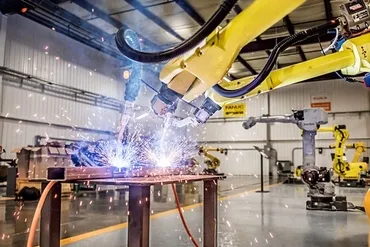
Robots being used in steel mills
Industrial robots are now being integrated into steel mill to help improve the efficiency and product quality. The industrial robots are able to create a very accurate marking system with an extremely short cycle time, a compact footprint, reliability, robustness, and an easy-to-apply marking medium.
- Innovation & Trends
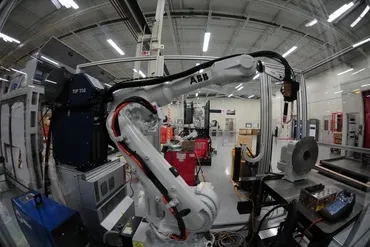
The Benefits of TOP TIG Welding
TOP-TIG welding is a user friendly, advanced innovation (a branch of TIG welding) that uses new technology to deliver the highest possible energy with the lowest possible heat. TOP TIG welding brings faster speeds and optimal quality welds. If you are interested in automating your production line with TOP TIG welding, contact Robots.com experts today.
- Innovation & Trends
Industrial Welding Robots Improve Your Profitability and Productivity
According to Intrado GlobeNewswire, the global robotic welding market size was valued at $5.5 million in 2018, and is projected to reach $10.5 million by 2026, growing at a CAGR of 8.7% from 2019 to 2026. These numbers are no accident, as the market implements Industry 4.0, manufacturers will continue to seek ways to improve operations through automation. With no shortage of robotic welding equipment, the heavy investment by various industries in robotics technology has encouraged the further development of automated welding.
- Innovation & Trends
- Featured
Emerging 3D Vision Technologies for Industrial Robots
Learn about the emerging 3D vision technology that businesses are using for industrial robot applications.
Let's talk!
Request your quick quote today.