
Innovations in Construction Robots
Technology's advancements are creating a wide range of innovations in the construction robot industry. Whether it is I-beams or insulation, construction robots help to advance the production process across the globe.

The use of robots in industry continues to grow in traditional manufacturing areas, such as automobile manufacture and the manufacture of consumer goods. The use of robots in nontraditional areas, however, is also starting to increase. Robots used in the manufacture of construction goods, whether it’s I-beams or insulation, are becoming more advanced and growing in popularity in different parts of the world.
Insulation and Fanuc Robotics Systems
Fanuc Robotics is working to increase efficiency in the production of construction materials using robotic systems. Using robots and work cells to cut, stack, bundle, package, and palletize materials increases efficiency because robot systems can perform tasks faster and with better accuracy. The robots that Fanuc Robotics has created can manipulate fiberglass insulation, polyisocyanurate board insulation, house wrap, and pipe foam insulation to fit each customer’s unique order, and they can do it with little downtime.
One facility estimated that its Fanuc Robotics system could cut, put into cartons, palletize, and unitize 42 linear meters of polyisocyanurate board insulation per minute. However, different laminating conditions produce even faster times, up to 67 meters per minute. Companies that integrate robots into their workflow become more efficient and more competitive.
Construction robots are often used in the industry for fabrication. A few robots exist on the construction job site, but the majority of robots used in fabrication in the construction industry are not on the job site. Instead, they are used in building construction machinery, arc welding metal components, applying adhesives, and assembling doors and windows.
Robots Reduce Monotonous Tasks
Construction robots are also used in the handling and manipulation of bricks and other heavy blocks. Brick and concrete block laying can be challenging both physically and mentally when performed through human labor. While not many robots have been utilized on the job yet, trials have shown how robot use in this field could prove beneficial. A brick factory in France, Lhoist Refractaires, uses robotic systems for palletizing bricks. Generally, brick laying robots are built with vacuum grippers that can determine differences in blocks and manipulate the brick or concrete block.
Robotic systems can also be utilized to dispense concrete on the job site. Instead of human labor applying the concrete, a robot can layer concrete vertically to form a structure. This process is similar to the application of adhesive process, except that concrete is much heavier than typical adhesives.
Robots and Efficiency in Japanese Construction
Welding time on Japanese construction sites has dropped dramatically since the implementation of robotic welding systems. One firm developed a system that uses two six-axis robots to weld structural steel for buildings. The I-beams are cut and welded prior to being delivered to the construction site, resulting in little welding needing to be done onsite. Prior to delivery, holes for plumbing and electrical systems are cut into the beams. These cuts must be made with exceptional accuracy, usually within 0.16 mm. After the cuts are made, the robots attach a unique part number to each beam to ensure that each beam gets used for the right job. The efficiency of this robotics system has decreased the time it takes to put up steel in a building, allowing more time to develop other projects.
For more information, contact Robots.com online or at 877-762-6881.
Related Articles
You might be also interested in:
- Industry Solutions
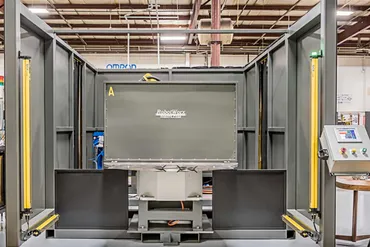
Setting up an efficient shop floor with robots
If you are considering integrating with industrial robots on your production line, it will help to plan your workspace properly for the greatest efficiency. Shop floor efficiency will be increased based on the five elements that are listed. This thoughtful layout will help you stay competitive in the manufacturing world.
- Industry Solutions
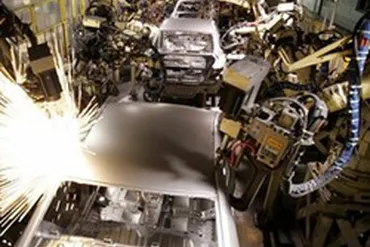
Reinventing Automotive Assembly with Robots
On the automotive assembly line, industrial robots perform faster and cheaper making them a better choice for manufacturers. The automotive assembly robots can be fitted with vision, making them more precise and create a more consistent product.
- Industry Solutions
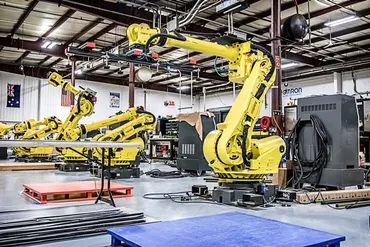
Foundry and Lean Manufacturing in Clyde, Ohio
The state of Ohio has a wide range of manufacturing businesses that have integrated industrial robots to improve their processes. The robotic technology that has been integrated has helped industries of all types such as steel cutting and molding plastics.
- Industry Solutions
Six-axis robots add flexibility to automotive component adhesives
For automotive production lines, six-axis robots are the solution for added flexibility and productivity. When compared with four-axis robots, six-axis robots add high levels of flexibility and enhance the automotive adhesive component. Six axis robots can perform operations that need to meet specific cycle times.
- Industry Solutions
They Can Take The Heat - Foundry Robots
A foundry robot can work in hazardous conditions without being damaged or effected. They help to remove humans form the harmful environment and hazardous materials that are present during this application. Foundry robots are up to the heat challenge and help to successfully complete a wide range of tasks in a more productive and efficient manner.
- Industry Solutions
Automotive Machine Loading Robots
Using machine loading industrial robots on the automotive line has increased the production speeds, cut costs, and increased the product quality. Machine loading robots are able to handle a variety of jobs and accomplish the job of a human worker in half the time.
Let's talk!
Request your quick quote today.