
Table Top Robots Solve Floor Space Issues
To help save work space, you may want to consider a table top robot. Table top robots can perform a variety of application all the while providing a reduced footprint and weight.

When you have a smaller project or limited floor space, a table top robot is the way to go.
With the ability to perform the same variety of applications as most other industrial robots, the reduced footprint and weight allows the robot to be attached to a table top.
There two main kinds of table top robotics, gated and cantilever. Gated robots attach to a support structure with two legs allowing the product to slide through the gate and be worked on. A cantilever table top robot attaches to a support structure with only one leg, allowing more work space and maneuvering of the product around the robot arm.
Robots.com offers table top robot arms that are similar to the larger robust industrial robots, only in a smaller and lighter package. One of the most popular is the Fanuc LR Mate 200iD robot. It is a six axis robot that can perform a large variety of applications, such as assembly, milling, foundry and material handling, just like the other LR mate models. A similar type of table top robot that Robotworx offers is the Motoman HP3.
A newer table top robot that is the Fanuc MiA robot series. It is perfect for material handling, part transfer, order picking, and packaging in small work areas. It is a 3 axis wrist maneuvers with incredible speed. These “spider” robots can include vision sensors and collision equipment.
If you have are interested in any type of table top robot, no matter what the application is, contact Robots.com to discuss your robotic needs.
Related Articles
You might be also interested in:
- General Robotics Information
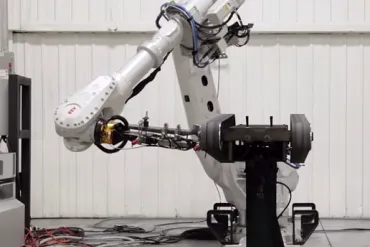
Rotating Workpieces with a Robotic Lathe
A robotic lathe can increase a companies productivity and money. Users of robotic lathes will experience an increase of 55% in productivity.
- General Robotics Information
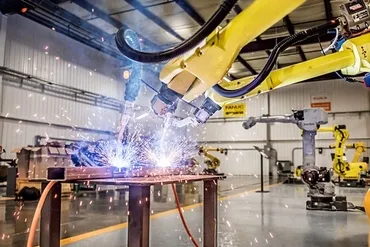
How to avoid weld smut
Weld smut can decrease the quality of a weld. That is why it is important to avoid weld smut. There are a variety of ways to keep weld smut at bay on your production line.
- General Robotics Information
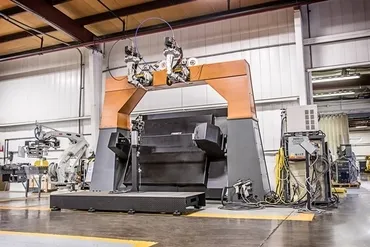
Gantry Robot Applications & Benefits
A gantry robot is hung overhead on a linear track that can move back and forth. Gantry robots are typically used for material handling applications but can also be integrated into welding production lines. Gantry robots are advantageous as they are closer to the part they are working on while also being able to work at different angles than a floor mount.
- General Robotics Information
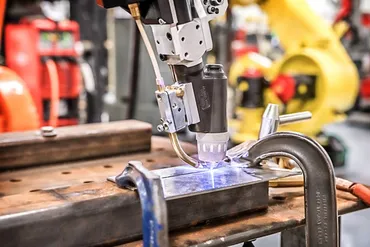
How to Weld Stainless Steel
If your production line needs to weld stainless steel with industrial robots, there are a few methods to do so. Stainless steel is within a class of iron-base materials that have a certain resistance to rusting and corrosion to do the presence of chromium. Chromium helps produce a tough, impervious layer to help shield it from rust and corrosion.
- General Robotics Information
What Are Autonomous Industrial Robots? Guide to AMRs
Unlike traditional robots that require direct programming or constant oversight, autonomous robots are capable of making real-time decisions, navigating dynamic environments, and adapting to changing conditions. They can operate continuously without breaks, increasing productivity and efficiency in manufacturing and warehouse settings.
- General Robotics Information
What Are Six-Axis Robots? A Comprehensive Definition
Industrial robots have various axis configurations. The vast majority of articulated robots, however, feature six axes, also called six degrees of freedom. 6-axis robots allow for greater flexibility and can perform a wider variety of applications than robots with fewer axes.
Let's talk!
Request your quick quote today.