
What makes the Fanuc M6iB/6S move
Manufacturers are quickly realizing the power of automation, as seen with the Fanuc M-6iB and -6S robot. The Fanuc robot arms are made up of a variety of important parts that helps the robot run smoothly and efficiently on a production line. Robots.com is proud to offer a wide range of parts for robots and is looking forward to serving you.

Industrial robots have been around in full force since the 1980’s. It was during that time that manufacturers realized that by automating their processes like welding, material handling, and material removal, they could save money while speeding up their applications. One such model was the Fanuc M6iB/6S. While this robot is efficient in its material handling applications, it is the internal parts that crank away year after year to keep production moving.
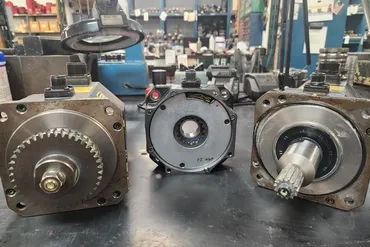
The servomotors found on every axis of the M-6iB-6S robot, (part numbers A06B-0202-B605 and A06B-0223-B605) are equipped with amplifiers that receive feedback from all parts of the robot. From this feedback, the motors can re-adjust and move in a way that works best for the robot’s operation.
Another important part of the M 6ib 6S is the group of speed reducers (part numbers A97L-0218-0288 and A97L-0218-0361) that are able to work in conjunction with the motors to slow down and redirect the motor’s output. They send it to the correct area of the robot that needs it, improving the robot’s overall functionality.
Finally is the M6ib6s’ wrist assembly, part number A290-7215-T502. Without this, the robot would essentially be useless. The wrist assembly is where the end effector is attached. Without the wrist, the EOAT cannot be attached to the arm, losing the robot’s function intent.
All of these parts are crucial to the robot’s function. These parts, including the robot system itself, can be purchased through Robots.com vast inventory. For more information, contact Robots.com today online or at 877-762-6881.
Related Articles
You might be also interested in:

- Manufacturers
Understanding Error Codes in Fanuc Industrial Robots
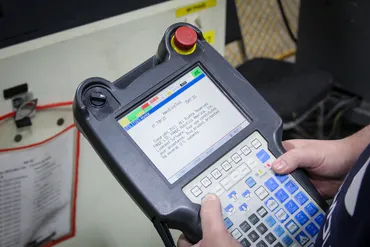
As modern industries evolve, the role of robots in manufacturing and automation has become much more integral in operations. Companies rely heavily on this technology and cannot afford shutdowns in production if this sophisticated machinery relays errors. Understanding Fanuc robot error codes is crucial for maintaining productivity and ensuring safety in your manufacturing environment. Let’s explain some common Fanuc error codes, their meanings, and potential solutions to minimize or avoid downtime.
- Manufacturers
Mastering User Alarms in Fanuc Robotic Programming
- Manufacturers
- Robot Motors
Addressing Common Fanuc Robot Motor Failures: How to Diagnose
No manufacturer wants to experience downtime caused by a failed robot motor. When a motor stops performing as expected, production can come to a standstill, impacting schedules, quality, and overall productivity. While Fanuc robots are built for reliability, their motors operate under demanding conditions, making them susceptible to predictable wear patterns and electrical or mechanical stress.
- Manufacturers
Top of the Line: Fanuc Deburring Robots
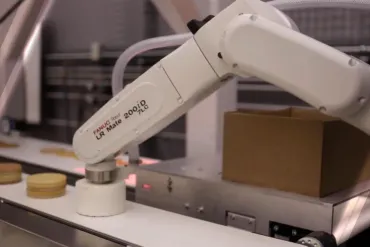
Fanuc has been in the robotic industry for years, so it is no surprise that they are creating best in class robots such as the LR Mate 200iC robot. The LR Mate 200iC by Fanuc can locate and deburr a part using the optional iRVision and an FS-10iA Force Sensor. Furthermore, the Fanuc 200iC has a great wrist load capacity, repeatability, work envelope, and speed.
- Manufacturers
Robotic Revolution: How Fanuc Robots Put Thanksgiving Dinner on Your Table
Thanksgiving – a time for feasting and gratitude. Behind the scenes, Fanuc robots play a pivotal role in bringing this festive meal to your table. At T.I.E. Industrial, we provide refurbished Fanuc robots that are integral to this process. This blog will delve into the various applications of these robots in Thanksgiving food preparation and the importance of food-grade robotics.
- Manufacturers
Fanuc Collaborative Robots: The Mini Series
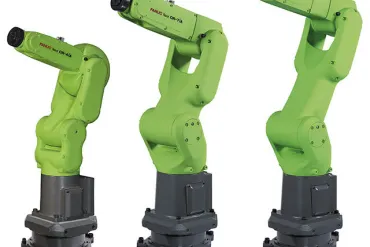
Fanuc now offers a collaborative mini-series with the CR-4iA, the CR-7iA, and the CR-7iA/L extended reach. Collaborative robots can work side by side with human workers without the need for any safety fencing. Furthermore, they are small and flexible, saving you on floor space and money. Contact Robots.com experts today to start the integration of a Fanuc collaborative robot from the mini series.
Let's talk!
Request your quick quote today.