
Kuka and Robotic Milling
KUKA created one of the first 6 axes robots and is now one of the leading producers of industrial robots. They continue to innovate and create products that are cutting edge.

KUKA is a German based robotics company that is one of the leading producers of industrial robots in the world. They originally created the world’s first 6 axes robot in 1973 and today their robots are used among several industries including automotive, metal working, and food. Their main headquarters is located in Augsburg, Germany but they also have a North American headquarters in Shelby Township, Michigan.
As a leading manufacturer KUKA stays on top by keeping their product line up to date. One of their most recent additions is their robotic milling technology for metal cutting and prototyping applications. Robot milling is a process used to cut away material to form a specific structure, often a mold or prototype. KUKA robotic milling is capable of producing higher throughput, lower capital costs, and increase flexibility. A milling robot has the advantage of flexibility because of a large work envelope with a 6 axis structure, giving it the freedom it needs to maneuver. Milling robots also have the advantage of using a simple cell structure with multiple part fixtures in their work envelope, allowing the operator to fixture one part while the robot is milling. This helps to increase productivity which saves manufacturers time and money.
A KUKA milling robot such as the KR100 HA has a long reach of 2600mm with a 6 axis work envelope that allows the robot to be precise and flexible. The KUKA KR30 HA is another milling robot with a reach of 2033mm and a 6 axis work envelope. This unit uses fine gears making it an excellent choice for precision milling. Both units have 6 degrees of freedom with their axes allowing them to maneuver swiftly around objects and accurately cut even the most intricate parts.
For a quick quote please contact Robots.com online or at 877-762-6881.
Related Articles
You might be also interested in:

- Manufacturers
Understanding Error Codes in Fanuc Industrial Robots
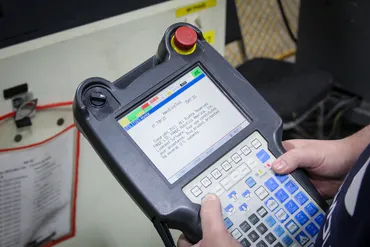
As modern industries evolve, the role of robots in manufacturing and automation has become much more integral in operations. Companies rely heavily on this technology and cannot afford shutdowns in production if this sophisticated machinery relays errors. Understanding Fanuc robot error codes is crucial for maintaining productivity and ensuring safety in your manufacturing environment. Let’s explain some common Fanuc error codes, their meanings, and potential solutions to minimize or avoid downtime.
- Manufacturers
Mastering User Alarms in Fanuc Robotic Programming
- Manufacturers
- Robot Motors
Addressing Common Fanuc Robot Motor Failures: How to Diagnose
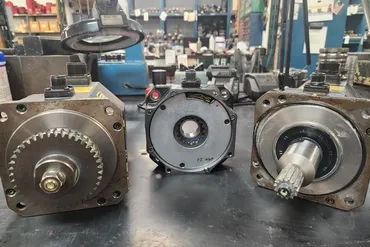
No manufacturer wants to experience downtime caused by a failed robot motor. When a motor stops performing as expected, production can come to a standstill, impacting schedules, quality, and overall productivity. While Fanuc robots are built for reliability, their motors operate under demanding conditions, making them susceptible to predictable wear patterns and electrical or mechanical stress.
- Manufacturers
Top of the Line: Fanuc Deburring Robots
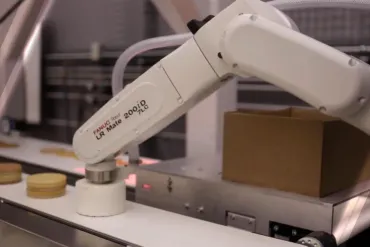
Fanuc has been in the robotic industry for years, so it is no surprise that they are creating best in class robots such as the LR Mate 200iC robot. The LR Mate 200iC by Fanuc can locate and deburr a part using the optional iRVision and an FS-10iA Force Sensor. Furthermore, the Fanuc 200iC has a great wrist load capacity, repeatability, work envelope, and speed.
- Manufacturers
Robotic Revolution: How Fanuc Robots Put Thanksgiving Dinner on Your Table
Thanksgiving – a time for feasting and gratitude. Behind the scenes, Fanuc robots play a pivotal role in bringing this festive meal to your table. At T.I.E. Industrial, we provide refurbished Fanuc robots that are integral to this process. This blog will delve into the various applications of these robots in Thanksgiving food preparation and the importance of food-grade robotics.
- Manufacturers
Fanuc Collaborative Robots: The Mini Series
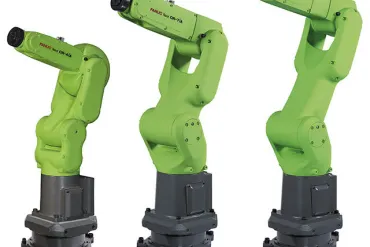
Fanuc now offers a collaborative mini-series with the CR-4iA, the CR-7iA, and the CR-7iA/L extended reach. Collaborative robots can work side by side with human workers without the need for any safety fencing. Furthermore, they are small and flexible, saving you on floor space and money. Contact Robots.com experts today to start the integration of a Fanuc collaborative robot from the mini series.
Let's talk!
Request your quick quote today.