
Robots help meet product demands
Industrial robots help to bring excellent repeatability, reliability, and consistency to the manufacturing process. The robots help meet product demands, reduce the cost of labor, and create a tailored solution for a wide range of applications including material handling, palletizing, and assembly.

Automation of the production process is essential as products and manufacturing processes become continually more complex. The manufacturing environment demands higher production rates than ever before. Manufactured goods require repeatability, reliability, and consistency, all of which have contributed to the growing demand for automation in manufacturing.
The cost of labor and declining cost of automation devices combine to ensure that the application of automation and robotics for production applications provide significant benefits. Robotic systems allow for precision, speed, repeatability, and flexibility to meet changing product demand and production requirements.
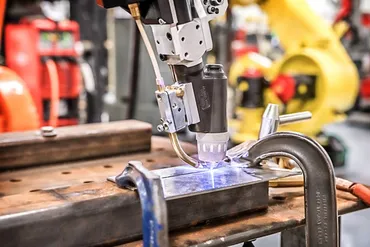
Robotic systems are tailored to meet the needs of each specific application. Cartesian, SCARA, or multi-axis robots can be chosen to automate a process, like material handling, palletizing, sorting, deburring, assembly, or welding.
Consumers are fickle, and demand products in new forms constantly, which plays to the strength of robotics’ flexibility to change while keeping production on track. Robotics plays a key role in quality control and testing of consumer products prior to packaging.
Motoman robots are used to test consumer goods, including electronics. Robots repetitively push buttons to determine the life expectancy of electronic devices. They also test the durability of a fabric over time by sweeping a human-like form over the fabric.
Fanuc robots are also used to test fabric. A system was installed that simulated a person getting in and out of a seat thousands of times to test the wear on the fabric. Tests like these ensure the product will work as the consumer expects.
Engineered Machined Products (EMP) is a leading producer of machined components and energy saving systems. Its continued growth relies on an investment in robotic automation, which allowed the company to reduce costs, enhance quality and turnaround times, increase capacity, and remain flexible during a changing economy. The use of Fanuc robots, especially those with robotic vision, allows EMP to not only automate processes but also accept new products for applications with minimal changeover. Over 40 Fanuc robots have been redeployed multiple times to take on new processes, and the robots’ uptime continually improves.
Robots.com provides Integration-Ready KUKA, Fanuc, ABB, and Motoman industrial robots that can help you meet your production demands. Contact us today online or at 877-762-6881 on how to optimize your production flow with robotic automation.
Related Articles
You might be also interested in:
- General Robotics Information
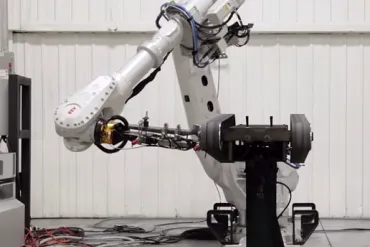
Rotating Workpieces with a Robotic Lathe
A robotic lathe can increase a companies productivity and money. Users of robotic lathes will experience an increase of 55% in productivity.
- General Robotics Information
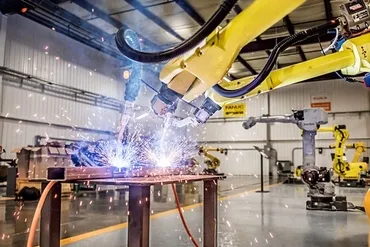
How to avoid weld smut
Weld smut can decrease the quality of a weld. That is why it is important to avoid weld smut. There are a variety of ways to keep weld smut at bay on your production line.
- General Robotics Information
Table Top Robots Solve Floor Space Issues
To help save work space, you may want to consider a table top robot. Table top robots can perform a variety of application all the while providing a reduced footprint and weight.
- General Robotics Information
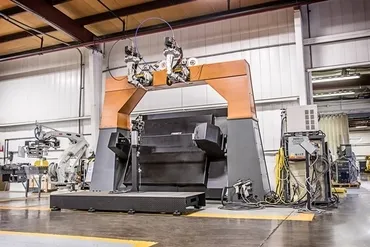
Gantry Robot Applications & Benefits
A gantry robot is hung overhead on a linear track that can move back and forth. Gantry robots are typically used for material handling applications but can also be integrated into welding production lines. Gantry robots are advantageous as they are closer to the part they are working on while also being able to work at different angles than a floor mount.
- General Robotics Information
How to Weld Stainless Steel
If your production line needs to weld stainless steel with industrial robots, there are a few methods to do so. Stainless steel is within a class of iron-base materials that have a certain resistance to rusting and corrosion to do the presence of chromium. Chromium helps produce a tough, impervious layer to help shield it from rust and corrosion.
- General Robotics Information
What Are Autonomous Industrial Robots? Guide to AMRs
Unlike traditional robots that require direct programming or constant oversight, autonomous robots are capable of making real-time decisions, navigating dynamic environments, and adapting to changing conditions. They can operate continuously without breaks, increasing productivity and efficiency in manufacturing and warehouse settings.
Let's talk!
Request your quick quote today.