
Rotating Workpieces with a Robotic Lathe
A robotic lathe can increase a companies productivity and money. Users of robotic lathes will experience an increase of 55% in productivity.

Introduction to Automated Lathes
In the world of machining, the lathe stands out as a pivotal tool, essential for shaping materials. Automating this process with a robotic lathe not only streamlines operations but also leads to significant savings in time and cost.
The Essence of a Lathe
A lathe is a machine tool which rotates the workpiece on its axis to perform various operations. When this process is automated, it saves both time and money.
Case Study: GKN Driveline’s Enhanced Production with Robotic Lathe
GKN Driveline, a notable player in the automotive industry, experienced remarkable improvements in vehicle component production by integrating a robotic lathe. A robotic lathe has boosted vehicle component production by half at GKN Driveline. Instead of using angle-approach grinders, hard-truning lathes have been used for machining critical features on an extruded steel component at this automotive supplier. They experienced an increase of 55% and a reduction of operators to run the automated lathe cell.
Advantages of Robotic Lathe in Automotive Manufacturing
The adoption of automated lathing in automotive manufacturing is not just about scaling production. It's also about achieving higher precision, better quality control, and reduced labor costs.
Fuji’s Advanced Automated Lathe Systems with Fanuc Controls
Fuji’s integration of Fanuc controls into their automated lathe systems exemplifies the advancements in this technology.
Diverse Range of Fuji Automated Lathes
- ANS-Series: Combines a single-spindle machine with options for turning, milling, or cutoff lathe operations, enhancing throughput.
- TN-Series: Offers a modular approach with a spindle, a turret, and a gantry robot, ideal for line integration.
- CS-Series: Features two spindle CNC lathes with slides for heavy cutting, ensuring superior surface finishes and extended tool life.
- ANW-Series: Capable of performing multiple operations including turning, facing, threading, and boring in a single setup, revolutionizing unmanned machining.
Specialized Models for Specific Needs
- VN-Series with Fanuc 18i-TA Control: Optimizes profits while minimizing floor space, perfect for large and heavy parts.
- FS4-Series with Fanuc 21i-TB: Achieves the fastest high-volume automation in its class with remarkably quick load/unload times.
- TNW-Series 6-Axis Twin: Integrates a gantry loader for comprehensive operations including turning, milling, drilling, and tapping – transforming raw materials into finished parts.
Fuji uses Fanuc controls as components in their automated lathe systems. The Fuji ANS-series, TN-series, CS-series, and ANW-series use Fanuc 0i-TD Control. The ANS-series integrates a modular single-spindle machine with a turning, milling, or cutoff lathe to increase throughput. The TN-series offers a modular machine with a spindle, a turret, and a gantry robot, suitable for line integration. The CS-series of two spindle CNC lathes feature slides for heavy cutting, superior surface finish, and longer tool life. Finally, the ANW-series can machine a workpiece front and back with turning, facing, threading, grooving, and boring in a single unmanned set-up.
The Fuji VN-series uses Fanuc 18i-TA Control to increase profits while decreasing machine floor space. Large and heavy parts are easily handled.
The FS4-series uses Fanuc 21i-TB to achieve the fastest high-volume lathe automation in its class with 2.5 seconds load/unload time.
The TNW-series 6-axis twin with an integrated gantry loader completes turning, milling, drilling, and tapping operations all on one machine. Materials in a raw state are transformed into completely finished parts with Fanuc control.
The Benefits of Automated Lathing in Various Industries
Automated lathing technology is not limited to the automotive sector. Its versatility and precision make it suitable for a wide range of industries, including aerospace, medical, and manufacturing.
Efficiency and Precision: The Hallmarks of Robotic Lathing
Automated lathes ensure high levels of efficiency and precision, critical in industries where quality and speed are paramount. The integration of advanced controls and automation software has further elevated the capabilities of these machines.
Robots.com: Your Partner in Advanced Lathing Solutions
At Robots.com, we offer a comprehensive range of automated lathes from industry leaders. Whether you’re looking to upgrade your existing setup or integrate a new automated lathe system, we have the expertise and options to meet your specific needs.
Explore Automated Lathing Options with Us
If you are interested in manipulating your parts with a lathe, contact us at Robots.com to discuss multiple options that are available online or at 877-762-6881.
Related Articles
You might be also interested in:
- General Robotics Information
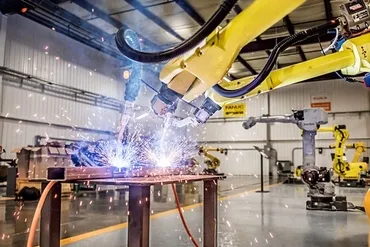
How to avoid weld smut
Weld smut can decrease the quality of a weld. That is why it is important to avoid weld smut. There are a variety of ways to keep weld smut at bay on your production line.
- General Robotics Information
Table Top Robots Solve Floor Space Issues
To help save work space, you may want to consider a table top robot. Table top robots can perform a variety of application all the while providing a reduced footprint and weight.
- General Robotics Information
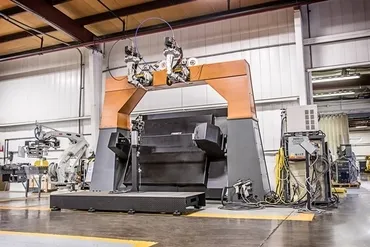
Gantry Robot Applications & Benefits
A gantry robot is hung overhead on a linear track that can move back and forth. Gantry robots are typically used for material handling applications but can also be integrated into welding production lines. Gantry robots are advantageous as they are closer to the part they are working on while also being able to work at different angles than a floor mount.
- General Robotics Information
How to Weld Stainless Steel
If your production line needs to weld stainless steel with industrial robots, there are a few methods to do so. Stainless steel is within a class of iron-base materials that have a certain resistance to rusting and corrosion to do the presence of chromium. Chromium helps produce a tough, impervious layer to help shield it from rust and corrosion.
- General Robotics Information
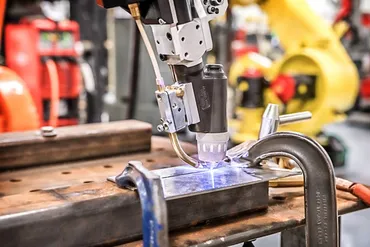
What Are Autonomous Industrial Robots? Guide to AMRs
Unlike traditional robots that require direct programming or constant oversight, autonomous robots are capable of making real-time decisions, navigating dynamic environments, and adapting to changing conditions. They can operate continuously without breaks, increasing productivity and efficiency in manufacturing and warehouse settings.
- General Robotics Information
What Are Six-Axis Robots? A Comprehensive Definition
Industrial robots have various axis configurations. The vast majority of articulated robots, however, feature six axes, also called six degrees of freedom. 6-axis robots allow for greater flexibility and can perform a wider variety of applications than robots with fewer axes.
Let's talk!
Request your quick quote today.