
What Are Six-Axis Robots? A Comprehensive Definition
Industrial robots have various axis configurations. The vast majority of articulated robots, however, feature six axes, also called six degrees of freedom. 6-axis robots allow for greater flexibility and can perform a wider variety of applications than robots with fewer axes.

Industrial robots have various axis configurations. The vast majority of articulated robots, however, feature six axes, also called six degrees of freedom. 6-axis robots allow for greater flexibility and can perform a wider variety of applications than robots with fewer axes.
6-Axis Robot Applications
Six axis robots allow a high level of precision with increased motor control. Robot applications include:
What does each axis do?
Axis 1
This axis, located at the robot base, allows the robot to rotate from left to right. This sweeping motion extends the work area to include the area on either side and behind the arm. This axis allows the robot to spin up to a full 180 degree range from the center point. This axis is also known as the Motoman: S and Fanuc: J1.
Axis 2
This axis allows the lower arm of the robot to extend forward and backward. It is the axis powering the movement of the entire lower arm. This axis is also known as the Motoman: L and Fanuc: J2.
Axis 3
The axis extends the robot's vertical reach. It allows the upper arm to raise and lower. On some articulated models, it allows the upper arm to reach behind the body, further expanding the work envelope. This axis gives the upper arm the better part access. This axis is also known as the Motoman: U and Fanuc: J3.
Axis 4
Working in conjunction with the axis 5, this axis aids in the positioning of the end effector and manipulation of the part. Known as the wrist roll, it rotates the upper arm in a circular motion moving parts between horizontal to vertical orientations. This axis is also known as the Motoman: R and Fanuc: J4.
Axis 5
This axis allows the wrist of the robot arm to tilt up and down. This axis is responsible for the pitch and yaw motion. The pitch, or bend, motion is up and down, much like opening and closing a box lid. Yaw moves left and right, like a door on hinges. This axis is also known as the Motoman: B and Fanuc: J5.
Axis 6
This is the wrist of the robot arm. It is responsible for a twisting motion, allowing it to rotate freely in a circular motion, both to position end effectors and to manipulate parts. It is usually capable of more than a 360 degree rotation in either a clockwise or counterclockwise direction. This axis is also known as the Motoman: T and Fanuc: J6.
Contact Us Today
Need a Six Axis Robot? The most popular six axis robots are manufactured by Yaskawa Motoman and Fanuc. To purchase a six axis robot, contact our sales department or call 877-762-6881.
Related Articles
You might be also interested in:
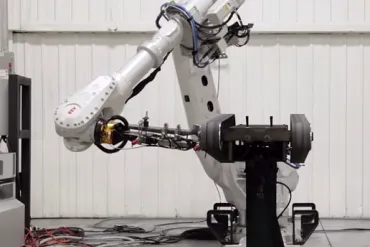
- General Robotics Information
Rotating Workpieces with a Robotic Lathe
A robotic lathe can increase a companies productivity and money. Users of robotic lathes will experience an increase of 55% in productivity.
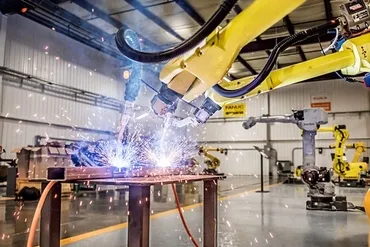
- General Robotics Information
How to avoid weld smut
Weld smut can decrease the quality of a weld. That is why it is important to avoid weld smut. There are a variety of ways to keep weld smut at bay on your production line.
- General Robotics Information
Table Top Robots Solve Floor Space Issues
To help save work space, you may want to consider a table top robot. Table top robots can perform a variety of application all the while providing a reduced footprint and weight.
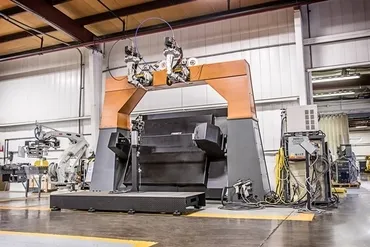
- General Robotics Information
Gantry Robot Applications & Benefits
A gantry robot is hung overhead on a linear track that can move back and forth. Gantry robots are typically used for material handling applications but can also be integrated into welding production lines. Gantry robots are advantageous as they are closer to the part they are working on while also being able to work at different angles than a floor mount.
- General Robotics Information
How to Weld Stainless Steel
If your production line needs to weld stainless steel with industrial robots, there are a few methods to do so. Stainless steel is within a class of iron-base materials that have a certain resistance to rusting and corrosion to do the presence of chromium. Chromium helps produce a tough, impervious layer to help shield it from rust and corrosion.
- General Robotics Information
What Are Autonomous Industrial Robots? Guide to AMRs
Unlike traditional robots that require direct programming or constant oversight, autonomous robots are capable of making real-time decisions, navigating dynamic environments, and adapting to changing conditions. They can operate continuously without breaks, increasing productivity and efficiency in manufacturing and warehouse settings.
Let's talk!
Request your quick quote today.