
Types of Automation
Automation succeeds at improving overall productivity, creating easier ways to conduct processes, while also decreasing health risks for human workers. Industrial robots enable decreased cycle times, increased product quality, and a better safety environment.

Automation is a method using a wide range of computer- and machine-aided tasks to help improve productivity and create easier ways to do business. Different types of automation are commonly used in different types of industries. For example, automated meters and pumps assist consumers daily when they pump their gas. In industrial settings, different types of automation provide benefits to companies including decreased part-cycle times, higher quality products, and increased worker safety.
Industrial Automation
Using technology to perform tasks that can be repetitive, dangerous, or otherwise unsuitable for humans is known as industrial automation. Numerically controlled (NC) equipment, industrial automated robots, flexible manufacturing systems (FMS), and computer-aided manufacturing (CAM) are all types of automation that industries implement into their factories.
Numerically Controlled Machines
Numerically controlled (NC) machines utilize computers to store, calculate, and execute operations that are usually performed by hand. A common example of an NC machine is the computerized numerical controlled (CNC) mill. Instead of positioning each cut by hand and meticulously moving the crank to cut each part, a CNC mill uses computers to analyze, cut, and mill each piece with precision. CNC mills and other NC machinery produce parts with fewer errors and higher accuracy.
Industrial Robots
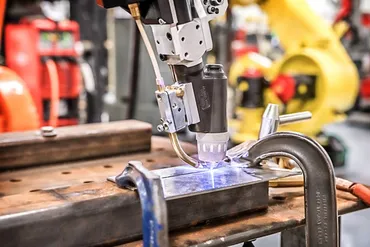
Automating industrial applications with an automated robotics systems provides many of the same benefits as NC equipment – higher quality parts, reduced cycle times, and increased savings to name a few. Industrial robots, like other automation types, can work 24 hours a day, 7 days a week to keep up with industry demands. Environments that prove to be dangerous for human workers are suitable for industrial robots. Despite a high initial cost, the return on investment (ROI) for an industrial automated robot is typically about six months due to the increased savings and production that robots provide. These machines can perform many industrial automated robotic applications including welding, material handling, assembly, palletizing, and painting.
Flexible Manufacturing Systems
A flexible manufacturing system (FMS) combines NC machines, industrial robots, and other types of industrial automation into one automation system. A FMS would typically produce similar products and parts but still maintain the flexibility to change parts or processes.
Computer-Aided Manufacturing
Computer-aided manufacturing (CAM) generalizes industrial automation one step further. CAM involves using computers in the production, planning, and control of FMS and, more generally, the entire manufacturing process. A common example of CAM is computer-aided design (CAD) or computer-aided design and drafting (CADD). CAD and CADD make use of computer programs to digitally plan products, parts, layouts, industrial robots, and a variety of other aspects of industrial settings. CAM also includes automated scheduling and manufacturing flow analysis.
Without various types of industrial automation, every aspect of manufacturing would have to be done manually. Cycle times would be much slower than they are today due to the reduced organization, consistency, and efficiency that various types of automation offer.
If you have more questions or are interested in integrating a robotic system on your production line, contact Robots.com experts today; online or at 877-762-6881.
Related Articles
You might be also interested in:
- General Robotics Information
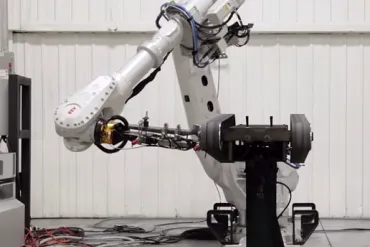
Rotating Workpieces with a Robotic Lathe
A robotic lathe can increase a companies productivity and money. Users of robotic lathes will experience an increase of 55% in productivity.
- General Robotics Information
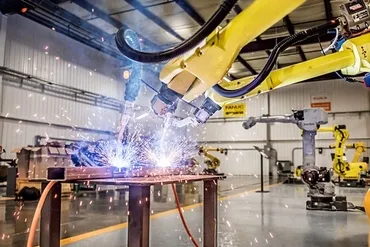
How to avoid weld smut
Weld smut can decrease the quality of a weld. That is why it is important to avoid weld smut. There are a variety of ways to keep weld smut at bay on your production line.
- General Robotics Information
Table Top Robots Solve Floor Space Issues
To help save work space, you may want to consider a table top robot. Table top robots can perform a variety of application all the while providing a reduced footprint and weight.
- General Robotics Information
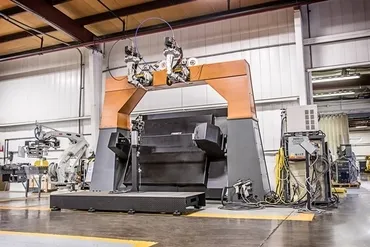
Gantry Robot Applications & Benefits
A gantry robot is hung overhead on a linear track that can move back and forth. Gantry robots are typically used for material handling applications but can also be integrated into welding production lines. Gantry robots are advantageous as they are closer to the part they are working on while also being able to work at different angles than a floor mount.
- General Robotics Information
How to Weld Stainless Steel
If your production line needs to weld stainless steel with industrial robots, there are a few methods to do so. Stainless steel is within a class of iron-base materials that have a certain resistance to rusting and corrosion to do the presence of chromium. Chromium helps produce a tough, impervious layer to help shield it from rust and corrosion.
- General Robotics Information
What Are Autonomous Industrial Robots? Guide to AMRs
Unlike traditional robots that require direct programming or constant oversight, autonomous robots are capable of making real-time decisions, navigating dynamic environments, and adapting to changing conditions. They can operate continuously without breaks, increasing productivity and efficiency in manufacturing and warehouse settings.
Let's talk!
Request your quick quote today.