
Why Consistent Preventative Maintenance Extends Robot Lifespan
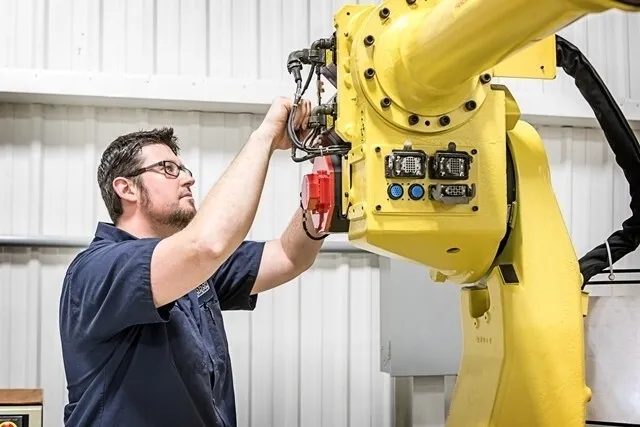
Protecting Your Automation Investment with Smart, Proactive Care
In manufacturing settings, your industrial robots aren’t just tools—they are the backbone of your productivity. Just like we maintain best practices for our physical health, keeping your robots healthy is equally necessary. What are the key best practices for robots? Consistent preventative maintenance.
Unlike reactive repairs that address failures after they happen, preventative maintenance is a forward-looking approach. It helps your robots run longer, perform better, and avoid catastrophic downtime. Name the industry —automotive, electronics, food and beverage, warehousing, or metal fabrication —the difference between a robot that lasts six years and one that lasts 15 often comes down to one thing—a consistent, targeted maintenance strategy.
What is Preventative Maintenance for Robots?
Preventative maintenance (PM) is the regular, planned servicing of a robot to avoid unexpected failures. It involves:
- Routine inspections
- Lubrication of joints and gears
- Cleaning of sensors and electronics
- Software diagnostics and updates
- Replacement of high-wear components
- Calibration and alignment checks
This plan doesn’t mean it’s just about fixing what’s broken—it’s about ensuring nothing breaks before beginning operations.
Real-World Impact: Applications That Rely on Healthy Robots
The effects of inconsistent maintenance are felt most where precision and uptime are critical:
- Spot welding in automotive plants using ABB IRB 6700s
- PCB placement in electronics with SCARA robots
- Palletizing frozen foods with FANUC M-410iC units
- CNC machine tending with Motoman MH50 robots
- Laser cutting and plasma welding in metalworking applications
One neglected joint or dirty encoder can throw an entire operation off balance—costing thousands per hour in downtime.
Key Benefits of Preventative Maintenance
1. Prevents Damage and Wear Before It Happens
- Lubrication: Keeps internal gears and joints moving smoothly. For example, regularly greasing a KUKA KR 60-3 can reduce wear and extend its joint life by thousands of hours.
- Cleaning: Dust buildup leads to overheating, sensor blockage, and shortened board life. Removing contaminants, especially in metal and wood shops, is crucial.
- Visual Inspections: Spotting frayed cabling, oil leaks, or corrosion early prevents more extensive component failure.
2. Minimizes Unplanned Downtime
Unscheduled downtime doesn’t just halt production—it derails timelines and budgets. With preventative care:
- Maintenance is done on your schedule, not when a robot breaks mid-shift.
- Early warnings (vibration, noise, heat) are addressed before causing a full failure.
For instance, checking gear backlash and motor torque on a FANUC M-10iA quarterly can prevent mid-cycle breakdowns in pick-and-place systems.
3. Restores and Maintains Peak Performance
Over time, even small variances in movement can affect product quality. Preventative maintenance involves:
- Calibration: Realigns the robot’s movements to match its programming.
- Component replacement: Swapping out worn reducers, belts, and batteries before failure restores like-new performance.
This is vital in operations like automated inspection or precision gluing, where tolerance errors can mean costly rework.
4. Lowers Long-Term Maintenance and Repair Costs
It’s simple math: catching an inexpensive issue today is far cheaper than fixing a high-dollar failure tomorrow. For example:
- Ignoring a high-resistance motor bearing in a Motoman HP20 could result in drive unit failure and motor burnout.
- Replacing a cooling fan proactively prevents overheating that could fry controller boards, costing thousands.
5. Improves Safety for Workers and Equipment
Robots that are out of spec—whether due to encoder drift, loose mounts, or failing brakes—can behave unpredictably. Consistent PM:
- Keeps movement predictable and within tolerance
- Reduces sudden stops or erratic motions
- Ensures safety sensors, interlocks, and limiters are fully functional
This is especially critical for collaborative robots and robots in shared human environments.
Symptoms to Watch For—and How Preventative Maintenance Fixes Them
Symptom | Possible Cause | PM Solution |
Inaccurate positioning | Encoder drift or mechanical play | Recalibrate and check gear backlash |
Noisy joints or excessive vibration | Dry bearings or worn reducers | Lubricate and inspect joint components |
Overheating | Dust buildup or fan failure | Clean cooling systems and replace filters |
Sluggish motion or delay | Controller lag or dirty sensors | Update software and clean optical sensors |
Repeating alarms or fault codes | Electrical contact issues | Inspect cables and test I/O connections |
Building a Custom PM Schedule for Your Robot
Not all robots work under the same conditions. A high-speed FANUC LR Mate 200iD used in a cleanroom has different needs than a KUKA KR 210 running in a welding cell.
Factors that impact your PM plan:
- Robot model and age
- Daily operating hours
- Application type (e.g., arc welding vs. CNC tending)
- Environmental conditions (dust, temperature, moisture)
- Load types and cycle frequency
At Robots.com, our experts help you build a model-specific maintenance schedule—whether you’re managing one robot in a small shop or 50 in a huge factory.
Need Help? Robots.com Has Your Back
At Robots.com, part of the T.I.E. Industrial family, we’re more than a leading supplier of refurbished industrial robots—we’re a partner in your productivity. We provide:
- Professionally refurbished robots from FANUC, ABB, KUKA, and Motoman
- A huge inventory of replacement parts—from servo motors and drives to teach pendants
- Expert advice and technical support for setting up maintenance programs
- Robot service kits with filters, belts, and lubricants
- Diagnostic tools and CNC maintenance training to empower your in-house maintenance team
No matter what robot you are operating, our team can help you keep it running smoothly for years.
Extend Lifespan, Maximize ROI—Start with Preventative Maintenance Today
Why wait for something to break? Preventative maintenance is your insurance policy against production stoppages, costly part failures, and performance decline. A little care today means a lot less expense tomorrow—and more value from your robotics investment over time.
At Robots.com, we’re here to help you build a preventative maintenance plan that works for your team, your robots, and your bottom line.
Visit Robots.com today to explore our refurbished robot models, order parts, or speak with our team about scheduling a preventative maintenance consultation.
Boost reliability. Extend lifespan. Lower costs. The smartest manufacturers start with Robots.com.
Let's Talk! Request your quote today!
Related Articles
You might be also interested in:
- Robotics Applications
- Featured
Latest Advancements in Material Cutting Robotics
Read about the latest technological advancements in robotic material cutting.
- Innovation & Trends
- Featured
Emerging 3D Vision Technologies for Industrial Robots
Learn about the emerging 3D vision technology that businesses are using for industrial robot applications.

- Innovation & Trends
- Featured
Most Popular Industrial Robotic Applications for 2021 and Projections
Explore the most popular application trends of 2021 and what to expect in the future.
- Robotics Applications
- Featured
MAG Welding Defined
Automating your MAG welding process will help to bring faster and more consistent cycle times. A robotic MAG welder will also help to improve the weld quality, helping your customer's become more satisfied with the final product. If you are interested in integrating a new or refurbished robotic system, contact Robots.com experts today.
- Manufacturers
- Featured
AccuFast II Tackles Seams Quickly and with Quality
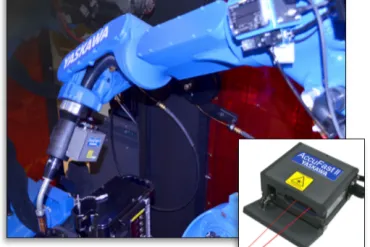
Motoman provides users with add-on features to help enhance the seam finding for their automated welding line. AccuFast II offers improved sensor capabilities that provide even higher amounts of reliability. It provides more readings for a wider range of materials and angles not formerly feasible.
- Robotics Applications
- Featured
Flexible Manufacturing Lines
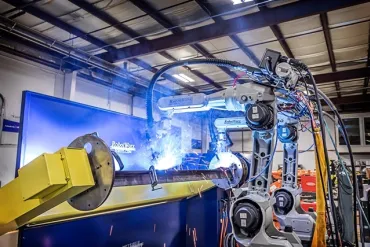
Each year the automation industry continues to innovate and bring solutions that will improve the productivity, flexibility, and efficiency on a wide range of production lines. This is seen with the flexible manufacturing that enables a robot to work on different types of products in the same workcell. Flexible manufacturing lines help to provide an increase in productivity and manufacturing volume.