
Key Benefits of Six-Axis Robots for Modern Factories
Six-axis industrial robots are one of the most popular robots integrated on the market today. A six-axis robots can bring a wide range of benefits to your production line. They can improve the motion on the production line as they have better wrist actions and flexibility. Furthermore, they bring specific robot software and programming capabilities to help improve the functionality of the production line.

The six-axis robot arm is the most commonly integrated industrial robot on the market today.
Industrial applications present such a wide range of needs with an even wider range of solutions. Industrial robot manufacturers have designed and developed a variety of industrial robot arms to automate manufacturing applications.
One robot axis is equivalent to one degree of freedom. Each axis, or degree of freedom, is responsible for moving the entire robot arm to the programmed point. Six axes allow a robot arm to move in the x, y, and z planes, as well as position itself using roll, pitch, and yaw movements.
Axes as a Differentiator
One major differentiator in the industrial robot world is number of axes. Some applications, such as palletizing, often require a robot arm with fewer axes, such as the Fanuc M-410 arm.
In other industrial applications, such as assembly, it might be advantageous to use an industrial robot with up to 15 axes, such as the Motoman SDA20D robot.
For many industrial tasks, however, the standard six-axis robot arm provides optimal strength, flexibility, and reach to complete the desired task. Click here to see what each axis does.
The Flexible Six-Axis Robot Arm
Most industrial robot arms that are seen in today’s manufacturing environments are composed of six-axes. Robot technology is constantly improving for six axis robots. Improved wrist action and flexibility, robot software and programming capabilities, and multiple mounting options are just some of the benefits six axis robots have to offer.
There is also a large range of robot sizes, payloads, and speeds to choose from. Six axis robots are also becoming easier to maintain, repair or replace.
The four most popular industrial robot manufacturers are Fanuc, Motoman, KUKA and ABB. They have designed and developed six-axis industrial robot arms both large and small to handle industrial applications.
There are multiple clean room and food grade options, as well as, other extreme work environment robots to prevent worker injury or hazard pay.
Let Us Help
We have over 35 years of experience helping individuals and companies chose and integrate robotic systems. Our knowledge can help lead you to the right robot for your specific application.
We also have both new and reconditioned six axis robots available. Offering more budget flexibility to those who need it. Contact us today by filling out this form, or call us at 877-762-6881.
Related Articles
You might be also interested in:
- General Robotics Information
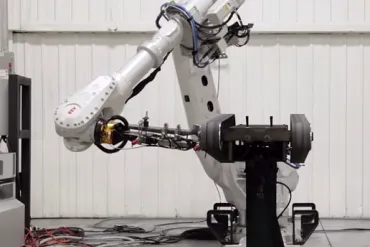
Rotating Workpieces with a Robotic Lathe
A robotic lathe can increase a companies productivity and money. Users of robotic lathes will experience an increase of 55% in productivity.
- General Robotics Information
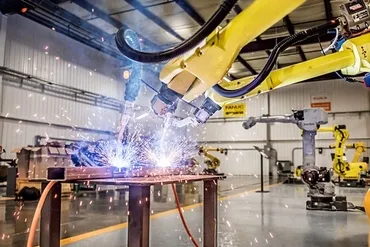
How to avoid weld smut
Weld smut can decrease the quality of a weld. That is why it is important to avoid weld smut. There are a variety of ways to keep weld smut at bay on your production line.
- General Robotics Information
Table Top Robots Solve Floor Space Issues
To help save work space, you may want to consider a table top robot. Table top robots can perform a variety of application all the while providing a reduced footprint and weight.
- General Robotics Information
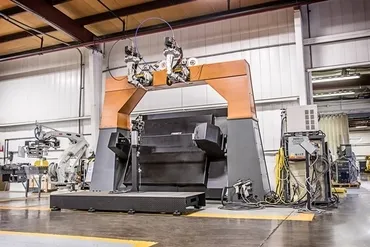
Gantry Robot Applications & Benefits
A gantry robot is hung overhead on a linear track that can move back and forth. Gantry robots are typically used for material handling applications but can also be integrated into welding production lines. Gantry robots are advantageous as they are closer to the part they are working on while also being able to work at different angles than a floor mount.
- General Robotics Information
How to Weld Stainless Steel
If your production line needs to weld stainless steel with industrial robots, there are a few methods to do so. Stainless steel is within a class of iron-base materials that have a certain resistance to rusting and corrosion to do the presence of chromium. Chromium helps produce a tough, impervious layer to help shield it from rust and corrosion.
- General Robotics Information
What Are Autonomous Industrial Robots? Guide to AMRs
Unlike traditional robots that require direct programming or constant oversight, autonomous robots are capable of making real-time decisions, navigating dynamic environments, and adapting to changing conditions. They can operate continuously without breaks, increasing productivity and efficiency in manufacturing and warehouse settings.
Let's talk!
Request your quick quote today.