
Fanuc Provides Tactile Intelligence With Force Control and Vision Technologies
Force control and Vision technologies with Fanuc robotics will help to increase the productivity and precision on the production line. These technologies have roboust hardware and intelligent software to help provide reduced cycle times, easy integration, and also reduced maintenance with fewer parts. If you are interested in adding tactile intelligence to your Fanuc robotic production line, contact Robots.com experts today.

Industrial robots now combine force sensing and robotic vision to create tactile intelligence. These two techniques have been introduced into the industry to increase the proven effectiveness of robots in manufacturing. As we charge on in the automation world, industrial robots are continually receiving upgrades and enhancements as technology is exponentially improving.
As a result, manufacturing is becoming more sophisticated by the day as robots are conquering more precise, flawless, and efficient applications with these advancements. Manufacturers are continuously improving these processes, increasing the production quality, all while achieving lower costs.
Fanuc's Force Sensors
Fanuc’s force sensors enable an almost human-like sense of touch, giving them the ability to detect force and torque applied to the EOAT in all 6-degrees of freedom. They provide craftsman-like precision and enable robots with a sense of “feel” to help with the most demanding mechanical assembly or material removal operations, such as contouring, measuring, or sanding. Additionally, robotic sanders can perform within 2% accuracy as the the direct measurements of tolerances can be set to create a consistent and repeatable environment.
These force sensors truly help improve product quality and process integrity as they aid in the control of velocity and force when objects are fit, aligned, buffed, trimmed, or assembled. As mentioned, they can detect force and moment (x, y, z, yaw, pitch, and roll) applied to it from external sources.
Applications that Benefit from Force Control and Vision
There are a variety of applications that work with the force control sensors and vision by Fanuc. These are as follows: precise fitting of machine parts, gear teeth engagement, push under constant force and product life cycle tests (automotive door operation, switching operations, applications requiring constant force), alignment of flat surface of one workpiece with a flat surface of another workpiece, grinding, or flexible part feeding.
Force Sensor Options
The force sensor by Fanuc robotics is made up of a sensor head, sensor adapter, and sensor cable. There are two different options for set-up of the force sensors: a Remote or Fixture-Mounted sensor and a Faceplate-Mounted sensor.
- The Faceplate Mounted sensor is mounted to the robot faceplate where the robot holds the sensor and presents it to the part.
- The Remote/Fixture-Mounted sensor is mounted on a fixture or in a location away from the robot. The robot then holds the part and presents it to the Force Sensor. Mounting the sensor on another location also reduces the weight of the end effector and enables the robot to carry different tools. Additionally, to help provide solutions for a variety of jobs and applications, there are five different sensor sizes are suitable for 6-axis robots to support payload classes up to 250 kg (15, 40, 100 and 250 kg). In order to further enhance the force sensing, there are several algorithms and intelligent features available, increasing the overall performance.
- Constant Push enables the robot to give a soft, constant push of force in one direction for a specified time.
- Face Match provides the robot with the ability to align and match the face of the workpiece held in the robot hand with the face of the object. This provides uniform alignment between a robot held component and contact surface of a sub-assembly.
- Shaft Insert/Bearing, Insert/Groove, Insert/Square, Insert/Clutch Insert allows loose fitting by aligning the angle and position of a shaft with a hotel for the insertion of varying shapes.
- Phase Match Insert performs phase matching of teeth, such as key shaft insertion and gear engagement, by rotating and meshing them before final insertion.
- Hole Search gives the robot the ability search for a hole by moving the shaft or object to be inserted at right angles to the hole, following by an insertion.
- Contouring Function traces the surface of a workpiece while applying a constant force with a tool such as a grinder. When sanding, grinding, and polishing operations are working with uneven or irregular surfaces, this feature measures and is able to apply constant force to the tool and surface and follow the uneven surface even if it is different than the originally taught line. If the workpiece to be machined is too heavy or large, then it will be secured onto a table and the grinder will be attached to the robot. If the workpiece is too small, the tool is secured onto a table and the robot holds the workpiece. Either case is performed while a set force is applied.
- TP Program Auto Generation On is for processes requiring accurate contoured edges, this feature records the path of the workpiece and automatically generates a TP program.
- Two-Direction Push On- enables the robot to push down and in at the same time.
- Search Function is designed to help minimize the position and orientation error of the approach position prior to an insertion operation.
iRvision with Force Control
iRVision is also integrated to further enhance part location and evaluation. Intergrated Robot Machine Vision is the integration of a camera interface built into the robot controller. Cameras can be attached to the robot or places in remote locations. iRvision is designed to eliminate the need to place every workpiece in the same way, every time. It is a visual sensor system that can measure the position of each workpiece by using the cameras and then adjust the robot motion to adjust the workpiece accordingly.
iRVision is a great addition to any automated process. Some other benefits include: handling multiple parts at one time, reducing the floor space, making part changeovers a breeze, identifying parts in multiple orientations, locating parts in 2D or 3D, error proofing parts as they enter assembly, increasing throughput, and reducing or eliminating fixturing costs.
Additional Features Available
In order to be sure all sensors are in good, working condition, Fanuc has a built-in force sensor diagnosis that uses instructions to verify each force sensor. Also available are several software features that coordinate with force sensing to determine the force control performance. The force sensor data display in real time is a clear indicator of the performance impact for force control parameters adjustment. This helps to reduce the overall teaching time while also providing instantaneous feedback for production runs, making issues easy to diagnose.
There is a “Teach Pendant Program Auto Generation” to play back the monitored edges of the workpiece in the contouring process with force control. This program is important to help keep speeds and the push force consistent when travel speeds are low or when the robot reverses. This generates an automated TP program with positional information with Fanuc iRVision’s Image to Points feature. The iPendant user interface device enables the constant display of actual force variations during the force control operation.
ROBOGUIDE, Fanuc Robotics’ off-line programming software, can help in the development of your application as it uses 3D models of actual tooling, robots, and workcell parts to help prove everything accurate and save money and time.
Robots Recommended for Force Control
The majority of force sensors have an IP67 rating and can be used on a variety of robot models such as the LR Mate 200iC, M-10iA, M-20iA, M-710iC, and R-2000iB.
Get Fanuc Force Sensors and iRvision, today!
It is easy to see why force sensors and iRVision are now imperative on the production line. Whether it be for assembly or sanding, the combination will provide an increase in productivity and high precision. Equally beneficial are the facts that there is complete integration into the robot for faster processing, the support of practice-proven standard functions, and robust hardware and intelligent software for reduced cycle times. Additionally, the setups are fast and easy, thanks to easy integration and fewer parts to help maintain maximum up-time.
For more information, contact Robots.com representatives today online or at 877-762-6881.
Related Articles
You might be also interested in:
- Manufacturers
Understanding Error Codes in Fanuc Industrial Robots
As modern industries evolve, the role of robots in manufacturing and automation has become much more integral in operations. Companies rely heavily on this technology and cannot afford shutdowns in production if this sophisticated machinery relays errors. Understanding Fanuc robot error codes is crucial for maintaining productivity and ensuring safety in your manufacturing environment. Let’s explain some common Fanuc error codes, their meanings, and potential solutions to minimize or avoid downtime.
- Manufacturers
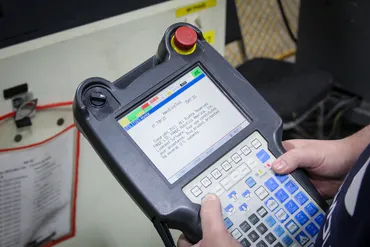
Mastering User Alarms in Fanuc Robotic Programming
- Manufacturers
- Robot Motors
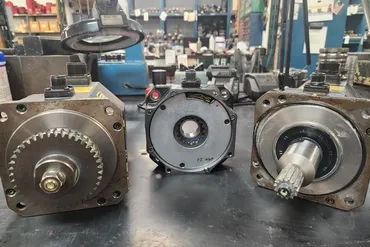
Addressing Common Fanuc Robot Motor Failures: How to Diagnose
No manufacturer wants to experience downtime caused by a failed robot motor. When a motor stops performing as expected, production can come to a standstill, impacting schedules, quality, and overall productivity. While Fanuc robots are built for reliability, their motors operate under demanding conditions, making them susceptible to predictable wear patterns and electrical or mechanical stress.
- Manufacturers
Top of the Line: Fanuc Deburring Robots
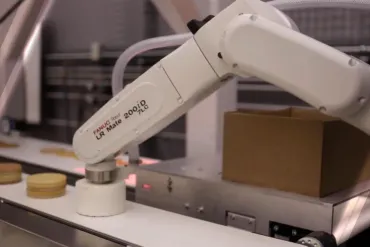
Fanuc has been in the robotic industry for years, so it is no surprise that they are creating best in class robots such as the LR Mate 200iC robot. The LR Mate 200iC by Fanuc can locate and deburr a part using the optional iRVision and an FS-10iA Force Sensor. Furthermore, the Fanuc 200iC has a great wrist load capacity, repeatability, work envelope, and speed.
- Manufacturers
Robotic Revolution: How Fanuc Robots Put Thanksgiving Dinner on Your Table
Thanksgiving – a time for feasting and gratitude. Behind the scenes, Fanuc robots play a pivotal role in bringing this festive meal to your table. At T.I.E. Industrial, we provide refurbished Fanuc robots that are integral to this process. This blog will delve into the various applications of these robots in Thanksgiving food preparation and the importance of food-grade robotics.
- Manufacturers
Fanuc Collaborative Robots: The Mini Series
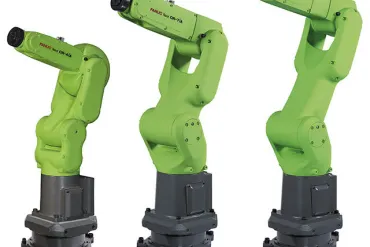
Fanuc now offers a collaborative mini-series with the CR-4iA, the CR-7iA, and the CR-7iA/L extended reach. Collaborative robots can work side by side with human workers without the need for any safety fencing. Furthermore, they are small and flexible, saving you on floor space and money. Contact Robots.com experts today to start the integration of a Fanuc collaborative robot from the mini series.
Let's talk!
Request your quick quote today.