
Selecting a Proper Robot
Automating your production line will help to boost production, improve part handling, and increase overall worker safety. Before choosing the exact robot you will purchase, it is important to consider what exactly your robot will do and what your specific production line needs will be.

Choosing to automate a shop or production line with robots is a decision that should be made enthusiastically, yet thoughtfully. Robots can boost production, improve part handling, and free workers from backbreaking and expensive manual labor.
There are several considerations in selecting a robot, the first being to determine what exactly the robot will do. Next, the payload that the robot will need to lift must be established. One caution with payload is to be sure to factor in the weight of the end-of-arm-tooling (EOAT) in the total payload consideration. End-of-arm-tooling can include implements like grippers, vacuum grips, welders, or drills. Then the space the robot will work in needs to be considered. This includes both how far the robot needs to reach and what its range-of-motion needs to be to effectively do the job. Based on that information, it will be clear if the shop has enough space to accommodate the necessary robot range-of-motion.
Once the specifications of application, reach, footprint, and payload are defined, the potential robot buyer must consider budget. Budget limits will define what robot manufacturer to shop for as well as whether a new or refurbished refurbished robot should be considered.
A good example of how to choose the right robot(s) is the Mennie Machine Company of Mark, Illinois. The Mennie Machine Company specializes in high quality machined castings and forgings for the automotive and construction market. Mennie’s decision to automate its production took into account the fact that it had relatively heavy and awkward parts that are ideal candidates for automation.
In selecting a robot type, Mennie’s had to consider several factors. First, they had to determine how far the robots needed to reach, how they needed to move, and what they had to pick up or handle. Second, they had to determine if they had the space for the robots to be able to move and if they could even be mounted in the way that Mennie’s needed. Lastly, they had to determine what kind of dexterity and gripper type the robots needed to have to appropriately handle the parts. With all of these factors considered, Mennie’s selected the Fanuc M-6i, M-16i, S-430iFand LR Mate 100i.
The Mennie Machine Company was able to choose the right robot to automate several complex processes from drilling, to heat-treating, and grinding. Mennie’s robot selection was effective because it considered what kind of part each Fanuc robot would need to be working with and made sure to select the right robot with enough gripping or machining attachment options to assure the job could be done. In Mennie’s process, the M-6i and M-16i robots, capable of lifting 13.2 lbs and 35 lbs respectively, primarily load and unload metal parts into a series of different lathes, drillers and rollers. The S-430iF, capable of lifting 286 lbs, then sequentially loads and unloads pallets of the parts into and out of four machines that perform various groove and ream operations.
Mennie’s also made sure the robot cells would be easily accessible by fork trucks or conveyors for product movement and for robot maintenance. Overall, Mennie’s was able to increase its machine uptime by 15% and cut production costs by 25% because they chose the right robots for their production line. Clearly, once the decision to automate a shop is made, the most important thing is selecting the proper robot(s) to accomplish the task at hand.
For more information on choosing the right robot, contact Robots.com representatives online or at 877-762-6881.
Related Articles
You might be also interested in:
- Industry Solutions
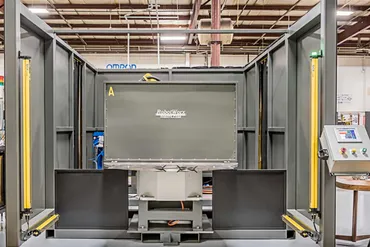
Setting up an efficient shop floor with robots
If you are considering integrating with industrial robots on your production line, it will help to plan your workspace properly for the greatest efficiency. Shop floor efficiency will be increased based on the five elements that are listed. This thoughtful layout will help you stay competitive in the manufacturing world.
- Industry Solutions
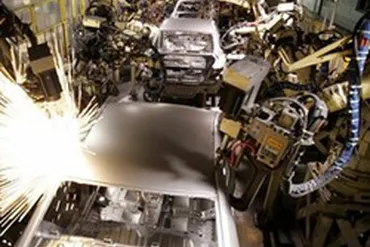
Reinventing Automotive Assembly with Robots
On the automotive assembly line, industrial robots perform faster and cheaper making them a better choice for manufacturers. The automotive assembly robots can be fitted with vision, making them more precise and create a more consistent product.
- Industry Solutions
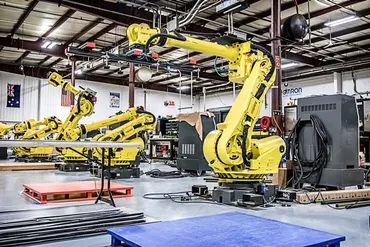
Foundry and Lean Manufacturing in Clyde, Ohio
The state of Ohio has a wide range of manufacturing businesses that have integrated industrial robots to improve their processes. The robotic technology that has been integrated has helped industries of all types such as steel cutting and molding plastics.
- Industry Solutions
Six-axis robots add flexibility to automotive component adhesives
For automotive production lines, six-axis robots are the solution for added flexibility and productivity. When compared with four-axis robots, six-axis robots add high levels of flexibility and enhance the automotive adhesive component. Six axis robots can perform operations that need to meet specific cycle times.
- Industry Solutions
They Can Take The Heat - Foundry Robots
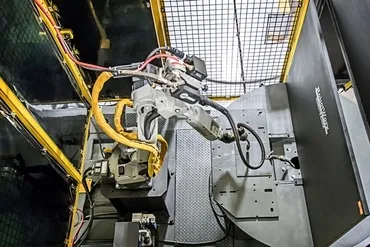
A foundry robot can work in hazardous conditions without being damaged or effected. They help to remove humans form the harmful environment and hazardous materials that are present during this application. Foundry robots are up to the heat challenge and help to successfully complete a wide range of tasks in a more productive and efficient manner.
- Industry Solutions
Automotive Machine Loading Robots
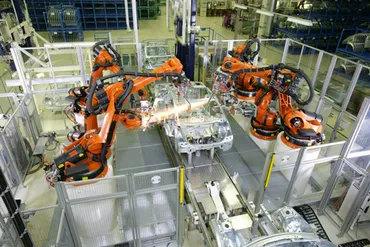
Using machine loading industrial robots on the automotive line has increased the production speeds, cut costs, and increased the product quality. Machine loading robots are able to handle a variety of jobs and accomplish the job of a human worker in half the time.
Let's talk!
Request your quick quote today.